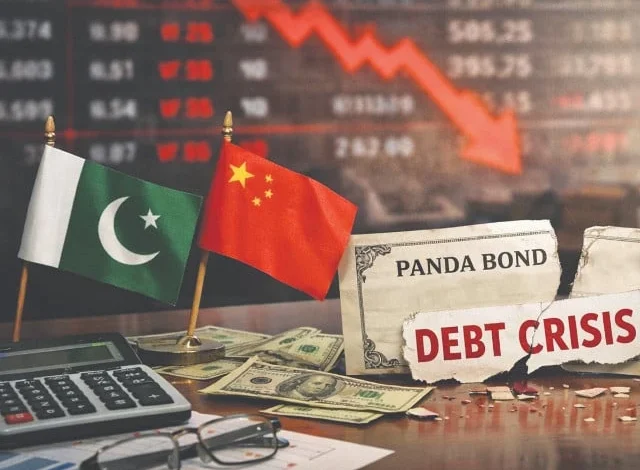
Panda bond. Design: Ibrahim Yahya
ISLAMABAD:
Pakistan’s plan to raise $250 million through Chinese Panda bonds has hit a snag due to the selection of disputed sites for two projects, which will be funded against the bond proceeds, including the $760 million worth Jinnah Medical Complex.
Because of its weak credit rating, Pakistan cannot directly access Chinese debt markets and has sought credit guarantees from the Asian Development Bank (ADB) and the Asian Infrastructure Investment Bank (AIIB).
Government officials told The Express Tribune that guarantors had raised objections to one telemetry project location in Azad Jammu & Kashmir (AJK) and to private ownership claims over the land originally allocated for the Jinnah Medical Complex.
According to officials of a multilateral lending agency, the AJK site issue was resolved after Pakistan agreed to remove the location following objections raised by India. However, the land issue for the Jinnah Medical Complex remains unresolved.
Of the $250 million total debt that Pakistan is desperately trying to raise through Panda bonds in Chinese markets since 2019, $152 million is planned for two projects. Finance Minister Muhammad Aurangzeb has set multiple deadlines for the bond issuance, with the latest expiring on February 28.
Sources said $76.5 million had been projected to be used for the installation of a telemetry system for real-time discharge monitoring at 27 key sites on the Indus Basin irrigation system. Another $76 million is meant for the Jinnah Medical Complex and Research Centre, part of a total funding plan of $760 million, or Rs213 billion.
The AIIB and ADB agreed to provide guarantees for the Panda bond issuance on the condition that the loan would fund sustainable, green projects. However, sources said the projects were selected hastily without adequate due diligence, leading to delays and embarrassment for Pakistani authorities.
Sources also cited internal procedural issues hampering the issuance of the bonds. The external finance wing of the Ministry of Finance, responsible for foreign commercial loans, sovereign bonds and budget support, raised objections to the process.
They said the external wing objected to being bypassed by the debt management office in Panda bond negotiations and in the hiring of consultants and foreign firms. Concerns were also raised over the process used to appoint transaction underwriters, Chinese legal counsel and a Chinese credit rating agency. In several instances, discussions were conducted by contractual staff, while the bureaucracy was not kept in the loop.
The Express Tribune waited four days for an official response from the Ministry of Finance spokesperson, but no reply was received despite repeated requests.
The spokesperson also did not comment on whether the bond would be floated by February 28 or on the status of the two proposed projects.
Both the ADB and AIIB agreed to provide guarantees only after Pakistan committed to using the funds for environmentally friendly projects. In return, the lenders will charge fees ranging from 0.8% to 1.25%, according to sources.
Pakistan is seeking entry into Chinese debt markets for the first time, but its credit rating, despite recent upgrades, remains a challenge. The guarantees would be issued directly by the ADB and AIIB to foreign private lenders.
If the bond is eventually floated, $76.5 million would be used for telemetry installation at 26 key Indus Basin sites, while $71 million would go to the ADB-funded Power Distribution Strengthening Project. Nearly $27 million has been earmarked for equipment for a cancer hospital in Islamabad, and $76 million for the Jinnah Medical Complex.
The bond issuance also depends on listing the Panda bond programme on China’s national interbank bond market, subject to approval by the National Association of Financial Market Institutional Investors (NAFMII).
Sources questioned whether it was prudent to use an AAA credit guarantee to raise only $250 million for three years, especially given currency convertibility risks.
However, the Ministry of Finance believes it can raise up to $1 billion through Panda bonds over the longer term and argues that base costs are lower. Sources said that once guarantee fees, issuance costs and potential currency swaps are included, the overall cost rises significantly.
Land dispute
Sources said the main obstacle remains the land identified for the Jinnah Medical Complex. The Capital Development Authority had selected a site in sector H-16 and informed Prime Minister Shehbaz Sharif that it was free of encumbrances.
In July 2024, Prime Minister Shehbaz Sharif performed the groundbreaking ceremony for the complex. Subsequently, lenders learned of pending dues claimed by occupants of the land and asked the government to resolve the matter.
Following guarantors’ objections, the government quietly shifted the project site, further delaying procedural requirements. A fresh environmental assessment will now be required to meet ADB and AIIB standards.
The chief executive officer of the Jinnah Medical Complex, Capt Mohammad Mehmood, confirmed that the site has been changed from H-16 to H-11 and that a new environmental and social impact assessment will be conducted.
Sources added that after India’s objection, the Mangla upstream site was removed from the telemetry project as it fell in disputed AJK territory. International lenders do not finance projects in disputed areas.
They said the finance ministry now faces the challenge of arranging alternative financing to offset any further delay in raising the $250 million through Panda bonds. Negotiations are under way with foreign lenders for additional borrowing, including a $600 million loan from Standard Chartered Bank.