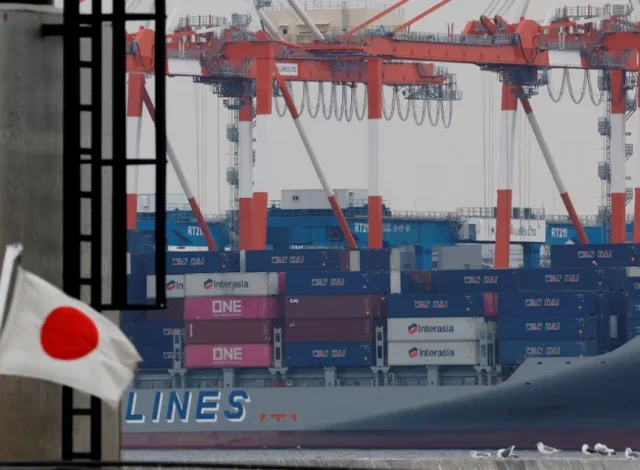
A Japanese national flag flutters in front of cargo containers at an industrial port in Tokyo, Japan, February 16, 2026. PHOTO: REUTERS
US trading partners in Asia were weighing fresh uncertainties this weekend after President Donald Trump announced a new tariff on imports, hours after the Supreme Court struck down many of the sweeping levies he used to launch a global trade war.
The court’s ruling invalidated a number of tariffs that the Trump administration had imposed on Asian export powerhouses from China and South Korea to Japan and Taiwan, the world’s largest chipmaker and a key player in tech supply chains.
Within hours, Trump said he would impose a new 10% duty on US imports from all countries starting on Tuesday, which he raised to 15% on Saturday. The levies, under a different law, are set for 150 days, prompting analysts to warn that more measures could follow, threatening more confusion for businesses and investors.
Before the ruling, Trump’s tariff push had strained Washington’s diplomatic relations across Asia, particularly for export-reliant economies integrated into US-bound supply chains.
In Japan, a government spokesman said on Saturday that Tokyo “will carefully examine the content of this ruling and the Trump administration’s response to it, and respond appropriately.”
On Sunday, Itsunori Onodera, an executive of Prime Minister Sanae Takaichi’s Liberal Democratic Party and a former defence minister, called Trump’s new tariffs “outrageous”.
“As an ally, I’m worried this will only accelerate countries distancing themselves from the US,” Onodera, the LDP tax policy chief, who is not in government, told a talk programme on Fuji Television.
Read: Trump says he is sending a hospital ship to Greenland
China, which is preparing to host Trump in late March, has not responded to the latest tariff moves while the country is on an extended holiday. But a senior financial official in China-ruled Hong Kong described the US situation as a “fiasco”.
Christopher Hui, Hong Kong’s secretary for financial services and the treasury, said Trump’s new levy served to underscore Hong Kong’s “unique trade advantages”.
“This shows the stability of Hong Kong’s policies and our certainty … it shows global investors the importance of predictability,” Hui told a media briefing on Saturday when asked how the new tariffs would affect the city’s economy.
Hong Kong operates as a separate customs territory from mainland China, a status that has shielded it from direct exposure to US tariffs targeting Chinese goods.
While Washington has imposed duties on mainland exports, Hong Kong-made products have generally faced lower tariff rates, allowing the city to maintain trade flows even as Sino-US tensions escalated.
As Trump’s levies escalated through 2025 and early 2026, corporate disclosures tracked by Reuters showed firms across the Asia‑Pacific region reporting financial hits, supply shifts and withdrawals.
Friday’s ruling concerns only the tariffs launched by Trump on the basis of the International Emergency Economic Powers Act, or IEEPA, intended for national emergencies.
Read More: Pakistan, Muslim bloc denounce US envoy remarks backing Israel expansion
Trade policy monitor Global Trade Alert estimated that by itself, the ruling cuts the trade-weighted average U.S. tariff almost in half from 15.4% to 8.3%.
For those countries with higher US tariff levels, the change is more dramatic. For China, Brazil and India, it will mean double-digit percentage-point cuts, although to still-high levels.
In Taiwan, the government said it was monitoring the situation closely, noting that the US government had yet to determine how to fully implement its trade deals with many countries.
“While the initial impact on Taiwan appears limited, the government will closely monitor developments and maintain close communication with the US to understand specific implementation details and respond appropriately,” a cabinet statement said.
Taiwan has signed two recent deals with the US – a memorandum of understanding last month that committed Taiwan to invest $250 billion, and a deal was signed this month to lower what Trump calls “reciprocal” tariffs.
Even before Trump raised his new levy to 15%, analysts said the court ruling might offer little relief for the global economy. They warned of looming confusion as trading nations brace for moves by Trump to find other means of using levies to circumvent the ruling.
Thailand’s Trade Policy and Strategy Office head Nantapong Chiralerspong said the ruling might even benefit the country’s exports as uncertainty drove a fresh round of “front-loading”, where shippers race to move goods to the US, fearing even higher tariffs.