She opposes new Olympic gender testing rules, saying they “undermine women’s rights”
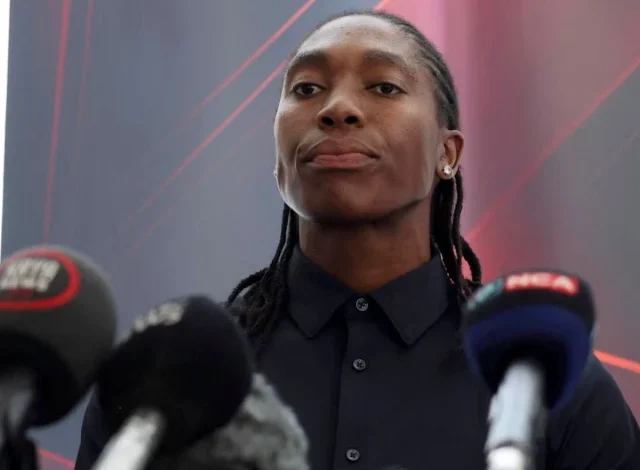
Caster Semenya says she will fight new gender testing regulations introduced by the International Olympic Committee for female competition. PHOTO: REUTERS
PARIS:
Double Olympic champion Caster Semenya says she intends to fight against the introduction of gender testing for the female category at the Olympics, a policy the South African insists “undermines women’s rights”.
The International Olympic Committee unveiled the policy last week and it is expected to become a universal rule for competitors in female elite sports after years of fragmented regulation that led to controversy.
Semenya has been at the centre of one of those controversies due to her long-running legal case against World Athletics over her right to compete on the track despite having a Difference of Sexual Development (DSD).
“We’re going to be vocal about it, we’re going to make noise until we’re heard,” the 35-year-old athlete told Reuters from Pretoria on Monday.
“Now it’s a matter of women standing for themselves to say, enough is enough. We are not going to be told how to do things.
“If really we are accepted as women to take part, why does my appearance or my voice, why do my inner parts need to be a problem to take part in the sport?”
DSDs are a group of rare conditions involving genes, hormones and reproductive organs. Some people with DSDs are raised as female but have XY sex chromosomes and blood testosterone levels in the male range.
The IOC had previously used chromosomal sex testing between 1968 and the 1996 Atlanta Olympics, before abandoning it in 1999 under pressure from the scientific community, which questioned its effectiveness, and from its own athletes’ commission.
Announcing the new policy on Thursday, an IOC statement said: “Eligibility for any female category event at the Olympic Games or any other IOC event, including individual and team sports, is now limited to biological females, determined on the basis of a one?time SRY gene screening.”
They will be carried out through a saliva sample, cheek swab or blood sample.
The new policy removes a potential source of conflict between the IOC and US President Donald Trump at the Los Angeles Olympics.
The IOC policy document said including “androgen-sensitive XY-DSD athletes” in the female category in events that rely on strength, power or endurance “runs fundamentally counter to ensuring fairness, safety and integrity in elite competition”.
Semenya, who won two Olympic and three world titles in the 800 metres before being limited to shorter events, believes the IOC got the science wrong.
Semenya said “there’s no science” that XY-DSD gave an athlete an advantage. “I’ve been there, I’ve done that. There’s no such thing as that,” she said.
“There are people who are delusional. There are people who are convinced because a woman is masculine, a woman is born with intersex conditions, the DSD, they’ve mentioned all those things (that they have an advantage).
“But what I say is that if you’re going to be a great athlete, it’s through hard work.”
The test that will be applied to all athletes who want to compete in the female class will be conducted by a cheek swab or saliva analysis.
There will be further investigation for any athletes who test positive for the SRY gene, which is on the Y chromosome and triggers the development of male characteristics in mammals.