New track recorded in mountains of northern Pakistan brings together artists from across continents to reimagine tradi
KARACHI:
A new track recorded in the mountains of northern Pakistan is bringing together musicians from across continents in an effort to reimagine traditional sounds for a global audience.
Music platform Humnava has released Qataghani, the third song from its first season, combining artists from Pakistan, Europe, and North Africa in what its creators describe as an “immersive” cross-cultural collaboration.
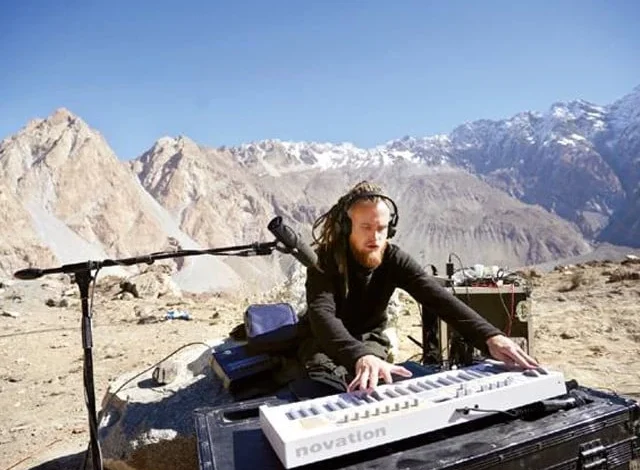
The song takes its name and inspiration from Qataghan, a historical region and cultural tradition associated with Central Asia. Built around layered tribal rhythms and high-energy composition, Qataghani was recorded against the dramatic backdrop of the Passu Cones, a location known for its jagged peaks and striking landscape.
At the centre of the project are Pakistani musicians Zulfiqar Jabbar Khan and Sherry Khattak, who curated the track. The song features Algerian singer Bakrin Timflati, whose vocals draw on folk traditions shaped by travel and lived experience.
The collaboration also includes German producer Dorian Jonas Goetsh alongside a quartet of rubab players from Hunza, blending electronic dance music elements with traditional instrumentation. French musician Blaise Merlin contributes electric violin, adding further texture to a composition that moves between chant, percussion, and synth-based sound.
The result is a soundscape that echoes musical traditions from across Afghanistan and Tajikistan, while remaining anchored in the cultural heritage of northern Pakistan.
Speaking about the track, Xulfi described it as something “physical, instinctive, and alive,” adding that its energy reflects both the environment in which it was recorded and the diversity of its contributors.
“It carries something ancient in spirit, but it also feels wild and current in a way that can travel anywhere,” he said.
The song is based on work by the late composer Ghulam Abbas Hassanabadi and has been re-arranged and produced for a contemporary audience. The accompanying video, directed by Soheb Akhtar, captures the stark beauty of the Hunza landscape, further reinforcing the connection between place and performance.
Its first season brought together more than 30 artists from countries including France, Germany, Algeria, and Zambia, who collaborated during a residency-style creative camp in Hunza.
The project reflects a growing trend in Pakistan’s music industry, where artists are increasingly looking beyond borders to collaborate and distribute their work globally through digital platforms.
In the early 1800s, Hunza Valley had played a vital role in the British “Great Game”. After the British suzerainty was established over South Asia by 19th century, the princely state of Jammu and Kashmir was created under the 1846 treaty of Amritsar. The British gained control of Hunza and Nagar during the Anglo-Brusho war, locally known as Jangir-e-Lae. Jangir-e-Lae was fought between the people of Nagar state and the troops of the British Raj at Nilt from 1 to 23 December 1891. The British troops faced strong resistance from the people of Nagar under the leadership of the Tham (chief) of that time, Azur Khan, at the Nilt Nallah (known as Jamila Mo Har). The people of Nagar fought for more than 20 days but were defeated due to a lack of armaments. Over 100 Nagaris lost their lives and 127 were imprisoned. On the British side, four British officers and over 50 Dogra levies lost their lives. The British retained Nagar’s status as a principality. Even after the revolt against the Maharaja of Kashmir and unconditional accession to Pakistan in 1948, Nagar’s status continued to be that of a princely state. Hunza too accepted the British suzerainty in 1891. The Mir of Hunza, Mir Safdar Ali Khan, fled to Kashgar, China, and the British army installed his brother Mir Nazim Khan (1892–1938) as a puppet ruler of Hunza Valley, but all orders were passed by British officers who were appointed in the capital Gilgit.