Says Pakistan is effectively and successfully managing the challenge of maintaining the balance of supply and demand
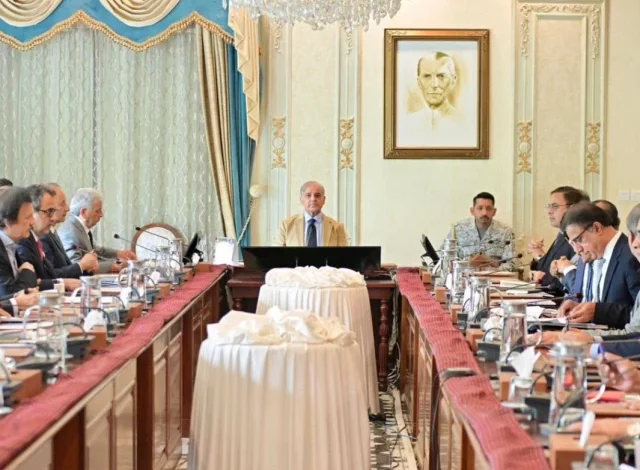
rime Minister Shehbaz Sharif chairs a meeting in Islamabad on Wednesday to review a strategy aimed at safeguarding the country from financial and economic impacts of the regional situation. Photo: APP
Prime Minister Shehbaz Sharif on Wednesday directed the relevant authorities to formulate a comprehensive strategy to curtail the economic effects on the public in the wake of the current regional situation, stressing that it should not disrupt production or the balance of supply and demand across economic sectors.
The development comes after the government earlier this week decided against imposing a smart lockdown due to differences among provinces during a high-level meeting chaired by the president and the prime minister.
The president directed the relevant authorities to take all possible measures to ease the burden of rising prices on the common man, while assuring participants that adequate fuel stocks were available to meet the country’s needs.
Read: PM orders strictness against smuggling, illegal hoarding of petroleum products amid fuel crunch
Chairing a review meeting on the proposed strategy, the prime minister noted that several countries were facing difficulties in maintaining the balance of supply and demand for essential commodities amid the prevailing situation.
“Pakistan was effectively and successfully managing this challenge,” the premier said while appreciating all relevant institutions for taking timely and effective measures to prevent any emergency in the supply and demand of essential goods.
The prime minister further highlighted that, after meeting domestic requirements for food and essential commodities, progress was being made successfully on a comprehensive strategy to export surplus production.
“The government remains committed to taking all necessary steps for economic stability, growth and public welfare,” he reaffirmed.
In view of rising trends in global market prices, the prime minister directed that a medium- and long-term comprehensive strategy be developed to tackle the financial and economic impact on the country. He instructed that the plan be formulated through close coordination among relevant ministries and institutions, keeping in view the stability and growth of all sectors of the economy.
He also directed that effective measures be proposed to minimise the impact of rising production costs on exports and overall economic output due to the global situation.
Also Read: Punjab schools switch to four-day week
“Available resources and opportunities should be fully utilised to prevent negative impacts on agricultural and industrial production amid the current economic challenges,” PM Shehbaz said.
During the briefing, it was informed that all relevant ministries and institutions were reviewing the economic impacts of the situation on a daily basis in line with the prime minister’s directives.
The meeting reviewed medium- and long-term planning to address financial and economic challenges arising from regional tensions. The prime minister appreciated the coordinated efforts of ministries and institutions and directed further improvement in collaboration.
Last month, the government sharply increased diesel and petrol prices by Rs55 per litre, or 20 per cent, citing the ongoing US-Israel and Iran conflict, which has disrupted global supply chains and pushed crude oil prices to a two-year high.
In response to the crisis, both the federal and provincial governments had introduced a series of austerity measures, including an additional weekly holiday, a reduction in free petrol allocations for ministers, curbs on protocol vehicles, and proposals to provide subsidised fuel for students.
Last week, the government had also approved a significant increase of Rs200 per litre in the fuel levy on high-octane fuel used in luxury vehicles, raising the total levy to Rs300 per litre and the price to Rs600 per litre.
Although it had been expected that the government might further increase petroleum prices due to prevailing uncertainty, it had refrained from doing so on two occasions, stating that Rs125 billion had been allocated through savings and development budget cuts to cushion consumers against rising global oil prices.