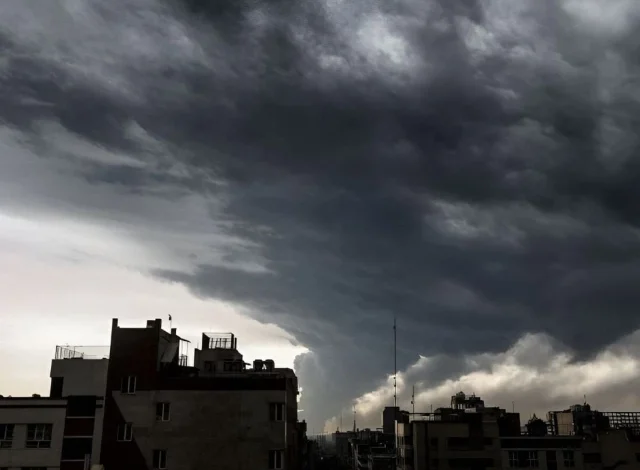
WHO says oil-tainted rain reported in Iran as refinery strike blankets Tehran in thick black smoke
Plumes of smoke from an oil facility linger and merge with the cloudy sky over Tehran, Iran, March 8, 2026. PHOTO: REUTERS
The World Health Organisation (WHO) warned on Tuesday that “black rain” and toxic air pollution following strikes on Iranian oil facilities could trigger respiratory problems, backing Tehran’s advisory urging residents to remain indoors.
The UN health agency, which maintains an office in Iran and works with authorities on health emergencies, said it had received several reports this week of rain contaminated with oil particles.
Thick black smoke blanketed Tehran on Monday after an oil refinery was struck, escalating attacks on Iran’s domestic energy infrastructure during the ongoing US-Israeli campaign.
“The black rain and the acidic rain coming with it is indeed a danger for the population, mainly respiratory,” WHO spokesperson Christian Lindmeier told a press briefing in Geneva, noting that Iranian authorities had advised people to stay indoors.
Read More: Trump says war could be over soon as Iran rallies behind new supreme leader
Asked whether the WHO supported that recommendation, he said it was sensible given the risks posed by strikes on oil storage facilities and refineries that have triggered fires and severely degraded air quality.
The attacks have released large amounts of toxic hydrocarbons, sulphur oxides and nitrogen compounds into the atmosphere, Lindmeier said.
Scientists warn that inhaling or coming into contact with contaminated smoke or particles may cause headaches, skin and eye irritation, and breathing difficulties. Prolonged exposure to some of the compounds could also increase the risk of certain cancers.
One video shared with Reuters by a WHO employee showed a staff member mopping up black liquid at the entrance of the organisation’s office in Tehran on March 8. Reuters could not independently verify the footage.
Researchers say the black rain was likely caused by rainfall mixing with airborne pollutants generated by the strikes and fires.
Akshay Deoras, a research scientist at the University of Reading, said the phenomenon had drawn public attention to the pollution but warned that longer-term exposure to toxic air posed the greater health threat.
He advised people to reduce exposure by staying indoors, wearing masks and covering their skin when outside. While air quality data remains limited, he noted that weather forecasts suggest drier conditions later in the week, which could gradually improve air quality unless further strikes occur.
“The risk of exposure goes down provided we don’t see fresh strikes,” Deoras said. “If new strikes happen, that could make the situation problematic again.”