Secures $1.7b AIIB portfolio, JICA lending resumption as Pakistan eyes rating upgrade
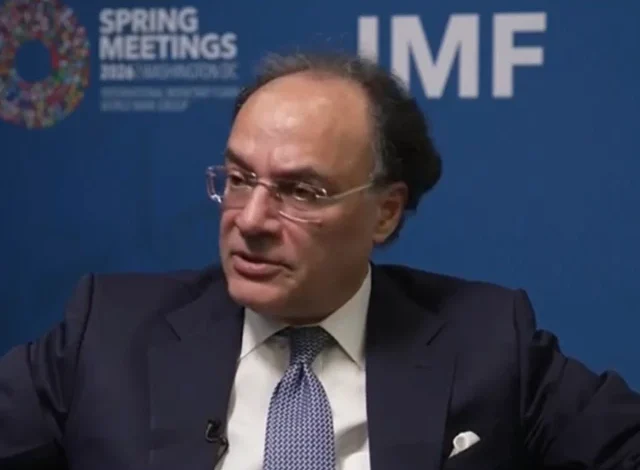
Finance Minister Muhammad Aurangzeb in an interview at the World Bank Spring Meetings 2026 with China Global Television Network’s program “The Heat”. PHOTO: SCREENGRAB
WASHINGTON:
Finance Minister Muhammad Aurangzeb concluded a productive final day of engagements at the International Monetary Fund (IMF) and World Bank Spring Meetings in Washington, securing renewed lending commitments and advancing Pakistan’s economic priorities, according to an official statement issued on Saturday.
In a meeting with US Treasury Deputy Secretary Francis Brooke, Aurangzeb shared Pakistan’s progress on macroeconomic stabilisation and re-entry into international capital markets. He highlighted investment opportunities in minerals and energy sectors and briefed the US side on digital and virtual asset regulation. Both sides discussed cooperation in energy, mineral development and strengthening anti-money laundering frameworks. Aurangzeb reaffirmed the depth of bilateral economic engagement and underscored the importance of continued US support for Pakistan’s IMF programme.
The finance minister also met Jenny Chapman, reaffirming Pakistan’s longstanding relationship with the United Kingdom. He highlighted that Pakistan has recorded a current account surplus during the first nine months of the fiscal year and remains committed to meeting all fiscal targets by end-June. He acknowledged support from Saudi Arabia and noted Pakistan’s successful return to international capital markets after four years through a bond issuance. He outlined the government’s response to the recent energy price shock through expenditure restraint, full price transmission and targeted digital subsidies. On climate resilience, he noted that recent flood-related relief was financed entirely through Pakistan’s own fiscal resources.
Aurangzeb met Shohei Hara, senior vice president of the Japan International Cooperation Agency (JICA), welcoming the resumption of JICA’s lending portfolio in Pakistan after a prolonged pause. He appreciated the identification of a water supply scheme in Faisalabad as the first project under the resumed Yen loan portfolio. Both sides agreed that Pakistan’s current negative net disbursement trend should be reversed through renewed active lending.
In a meeting with Asian Infrastructure Investment Bank (AIIB) President Zou Jiayi, Aurangzeb appreciated AIIB’s robust engagement in Pakistan, with an ongoing portfolio of $1.7 billion and an additional $1 billion in the pipeline. He highlighted Pakistan’s planned inaugural Panda bond issuance and recent Eurobond transaction as validations of macroeconomic stabilisation. He invited AIIB to align future engagement with Pakistan’s infrastructure priorities under the World Bank and ADB frameworks. Both sides acknowledged that Pakistan’s disbursement performance with AIIB has lagged behind other multilateral partners. Aurangzeb informed that the prime minister has constituted four dedicated working committees to address project implementation bottlenecks, including compliance, land acquisition, disbursement and procurement.
The finance minister separately held constructive meetings with S&P Global Ratings and Citibank. He informed both institutions that Pakistan has successfully concluded a staff-level agreement with the IMF, with board approval expected shortly. He highlighted the successful repayment of $1.4 billion in Eurobond obligations during the current month, additional Saudi financial support including a $3 billion facility and the extension of an existing $5 billion deposit to a three-year term through 2028, and Pakistan’s return to international capital markets through a private placement bond issuance priced at just under 7%. He outlined Pakistan’s medium-term Global Medium Term Note strategy, including Eurobonds, Sukuk and rupee-linked dollar-settled instruments, while also briefing them on progress towards the inaugural Panda bond. Aurangzeb expressed confidence that Pakistan’s improved macroeconomic fundamentals make a compelling case for a credit rating upgrade.
Later, the finance minister participated in a high-level roundtable titled ‘Delivering Social Protection Digitally: Lessons and Innovations from Pakistan, Middle East and North Africa,’ organised by the World Bank. The event showcased Pakistan’s digital public infrastructure journey and the digital transformation of the Benazir Income Support Programme. Aurangzeb drew parallels between the Covid-19 demand shock and the current Middle East supply shock, emphasising that countries investing early in governance and technology were better positioned to respond. He highlighted that targeted digital subsidies for two-wheelers, public transport users and small farmers are being disbursed seamlessly through existing payment systems. He stressed that digital social protection is not merely a payment mechanism but a powerful tool for financial inclusion and economic empowerment, particularly for women entering the formal financial system for the first time.