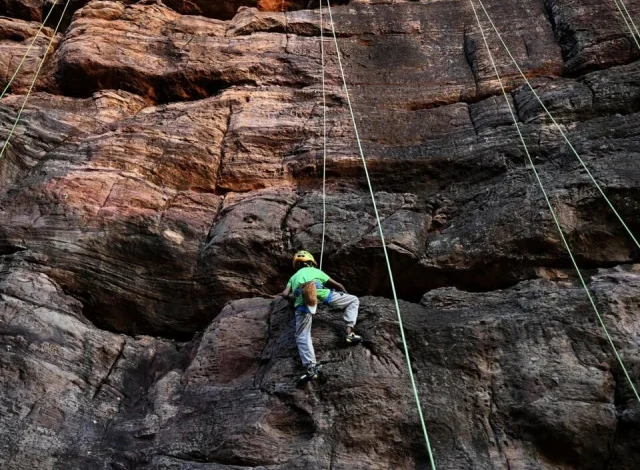
A young climber scales a rock wall in India. Photo: AFP
PUNE:
Blink and you might miss Indian speed climber Deepu Mallesh scaling a wall five buses high in five seconds.
India, a country obsessed with cricket, has seen a surge in popularity in climbing but those who want to compete internationally have had to crowdfund and there is little government recognition or help.
Some have had to quit the sport they love.
“What I like most about climbing is how raw and honest it is,” said 28-year-old Mallesh, who has climbed for his country and dreams of being the first Indian climber to qualify for the Olympics.
“It’s just you, the wall and the clock.”
Mallesh works part-time as a climbing instructor while pursuing his goal of reaching the 2028 Los Angeles Games.
“I have to somehow make some money. That is the only way for me to survive in this sport,” he said.
The Indian Mountaineering Foundation (IMF) estimates there are tens of thousands of people who sport-climb regularly, with more than a dozen climbing gyms opening in the last decade.
But the rise in those picking it up as a professional career is slow — high costs and scarce sponsorship deals hold back many.
There are about 3,500 climbers who compete across various levels in the country and among them, about 60 participate internationally annually.
Mallesh didn’t win at the world championship in China this month, but at 5.39 seconds he set a national record in men’s speed climbing.
He also qualified for the Asian Games in Japan in September-October.
Shoes, chalk powder
Mallesh only manages to compete with support from the IMF.
Previously he raised the cash to compete via crowdfunding. Two years ago he collected about one million rupees ($10,500) to attend six international competitions.
“I have had to miss competitions because I could not gather the requisite amount,” he said.
“If I get proper funding and proper support I might see my career through till the Olympics. Otherwise I will have to find something else to do.”
Since 2002, India have won nearly 70 medals in international climbing competitions, including in the Asian youth championships.
Among them is Joga Purty, who won silver in 2024.
Purty, 19, said she was lucky because she was sponsored by the Tata conglomerate.
“If I didn’t have this I also would be one of those who quit the sport,” she said.
A decent pair of shoes and a harness cost about 10,000 rupees ($106) each. A chalk bag, used to dust the hands for grip, costs 5,000 rupees.
“The shoes also will only last three to six months, sometimes even less depending on the athlete’s use,” she said. “And we have to carry an extra pair of shoes.”
Game-changer?
Unlike many other sports in India, there is little government support.
The IMF’s Keerthi Pais, 50, said the organisation was in talks to get the sport recognised under the National Sports Governance Act.
“This recognition will help them continue their climbing career,” Pais said.
Mallesh said wider recognition “would definitely help”.
“It’s not just about validation, it directly impacts support, funding, infrastructure and sponsorship opportunities,” he said.
Pais said government support to make it easier to build climbing gyms would help too.
“That will be the game-changer… this is how it will grow.”
Mumbai-based Shaiv Gandhi from The Indian Bouldering Company gym said facilities like his have been a catalyst for growth.
“I think the two biggest things that the commercial climbing gym help with is awareness… and the infrastructure in order to train for the sport,” the 30-year-old said.
“We already have a programme where we have told our instructors to keep an eye out for budding talent… if anyone you think has potential, let them climb.
“It’s on me.”